Chatan Yara (1668 - 1756)
(Some sources relate his name to a later period). Chatan Yara is a legendary figure in the Okinawan Martial Arts legacy. He traveled to Fukien\China in order to learn Chinese Kempo and weaponry and stayed there for 20 years. His teacher was Wong Chung-Yoh.
Takahara Peichin (1683 - 1760)
Takahara was born in Akata-Cho\Southern Shuri to an upper class family of Okinawan society. The term "Peichin" stands for "senior". Some sources claim that he was a Buddhist monk from Shaulin and Martial Art expert. He was well educated person. His expertises were astronomy and mapping and he indeed mapped Okinawa. Takahara traveled a lot during his lifetime. He was well known as a great fighter who emphasized ethical principals as "Ijo" (compassion, humility and modesty), "Fo" (seriousness, devotion and dedication) and "Katsu" (deep understanding and essence of techniques). Takahara regarded Martial arts as way of life and he is considered as "father of Okinawan Karate".
Takahara attributed a major importance to Kata and it's significances. He saw Kata as an efficient instrument to understand and improvement fighting techniques.
He was a student of Chatan Yara and his most famous student was "Tode" Sakugawa.
(Kushanku kung Yang)
Kushanku was a Chinese military envoy from Ming dynasty period. He was sent to Okinawa in 1756. The Chinese delegation was enumerated 36 families and they settled in Kumemura, near by Naha.
Kushanku was a well known Kempo expert (Shaulin Quan-Fa) and his influential on Okinawan Martial Arts (the local "Te") is very significant regarding to knowledge transfer as well as style influence. Kushanku taught a lot of Martial Art people in Okinawa, among them Chatan Yara and his famous student, Sakugawa Kanga.
In 1762 Kushanku completed his mission and returned to China, his homeland.
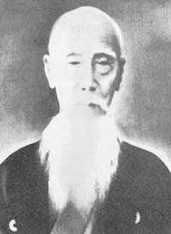
"Tode" Sakugawa Kanga (1733 - 1815)
Sakugawa started to study in his childhood. His first teacher was Takahara Peichin. In his 20th he continued to study with Kushanku. Sakugawa was the first teacher who used the term "TODE \ Chinese hand" and therefore his was called "Tode Sakugawa ". This information reinforces the general opinion that two fighting streams were existed in Okinawa concurrently, the first was the local "TE\hand" and the second was "TODE\Chinese hand". Sakugawa integrated the two streams under explicit etiquette rules hence the term "The first teacher" is related to him.
His most known student was Matsumura Sokon.
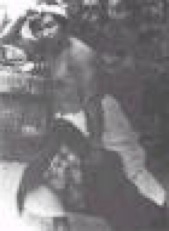
"Bushi" Matsumura Sokon (1797 - 1889)
One of very few who were awarded in the title of "Bushi" (warrior) by the Royal family. "Bushi" Matsumura is one of the most considered Okinawan Fighting Artists and a lot of stories and legends are told about him. He was the most famous student of Sakugawa.
After his teacher passed away he was adopted by the Royal family (Sho family) and was dispatched to study in Shaolin temple\China. Matsumura served as a bodyguard to king Shoko after his return. To be more precise, he served three reigns as a personal guard of the Royal descendants of King Shoen the seventeenth, King Shoko the eighteenth, King Shoku and the nineteenth King Shotai.
Matsumura is considered as the "Father of Shorin Ryu" (young forest).
He is the first to systemize "Shuri-Te", which became to "Shorin Ryu" in days to come.
Matsumura taught many famous students as Anko Itosu, Azato Yasutsune, Yabu Kentsu, Hanashiro Chomu and Kiyan Chotoku.
Matsumura wrote few books about Martial Arts and warrior ethics.
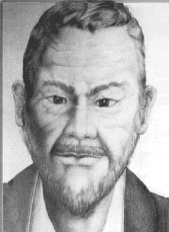
Itosu Yasutsune Anko (1830 - 1915)
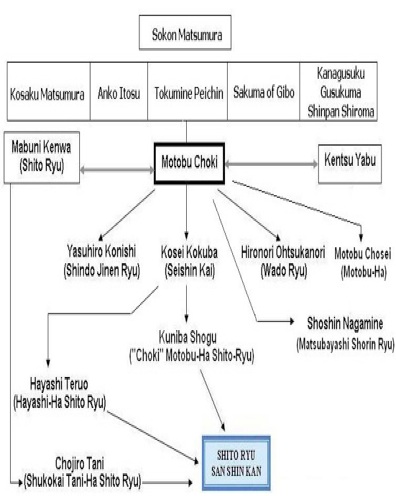
Born in Shuri and started to study under Matsumura Sokon. His nick name was "Anko" ("Iron Horse"). Yasutsune presented the Karate as health discipline activity for body strengthening. He brought Karate into the education system and from there to entire population. Among his famous students are Mabuni Kenwa (Shito Ryu), Chibana Choshin (Kobayashi Ryu), Funakoshi Gichin (Shotokan Ryu), Motobu Choki, Yabiku Moden and Toyoma Kanken.
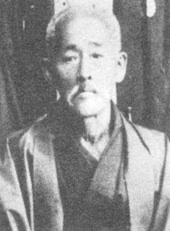
Higashionna (Higaonna) Kanryu (1851 - 1915)
Born in Naha and started to learn Karate under Matsumura Sokon. Later on Higashionna traveled to Fukien\China and learned Kempo under the teacher Liu Liukung. After his return to Okinawa Higashionna developed the "Naha-Te" style, which is characterized by combination of soft and hard techniques, beathing accentuation and white crane motives in Kata. His student and successor was Chojun Muyagi.
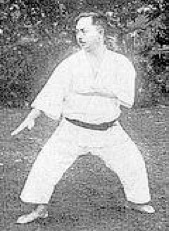
Mabuni Kenwa (1889 - 1952)
Founder of Shito Ryu. 17th generation to Keimochi dynasty (Aristocratic title of ranked families in Okinawa).
In 1902, at the age of 13 Mabuni Sensei learned Shuri-Te from Itosu Anku, in Shuri. In 1909, in order to broaden his knowledge, Mabuni started to learn in Naha under Higaonna Kanryu and continue the studding until Higaonna passed away, in 1915.
At the same year, 1915, his other teacher, Itosu Anko passed away too. According to the legend Mabuni was so upset that he visited Itosu's grave daily and performed Katas for more then a year in order to pay respect to his teacher.
In addition, Mabuni studied under Seisho Aragaki (1840-1920), To –te (Tode, "Chinese hand") expert, who taught Naha – Te, similar style as Higaonna, and was also Kobu-Jutsu (the art of traditional weaponry) expert and taught "Bo" and "Sai". Aragaki (Arakaki) had several nicknames: Kamadeunchu, "Maaya" ("The cat"), "Tsuji Peichin", "Chikudon Peichin" (officials of the local royal court). His death date is in vague, some historians maintain it was May 1918 while others claim to 1920.
Another influential source which took effect on Mabuni was: "Fukien - White crane fist", which Mabuni had learned from the teacher WU XIAN GUI (GO KENKI - in Japanese pronunciation).
Additional teachers with Mabuni had learn from are: Aragaki kamadeunchu (1840 - 1920), Sueyoshi Jino (1846 - 1920) and Tawada Shimbuko (1581 - 1920).
Mabuni completed his studding and his military service and joined the police.
In the year of 1918 Mabuni established a studding group which aimed to research the local fighting arts and their origins. The group members were well named personas as: Choshin Chibana, Funakoshi Gichin, Shinpan Shiroma, Anbun Tokuda, Seicho Tokumura, Choju Oshiro and Hoko Ishikawa.
In 1919 Mabuni was invited to demonstrate techniques in front of prince Kuni and prince Kacho in Okinawan schools.
When the local "Te" ("Tode") has arrived to Japan, the Japanese demanded to organize and institutionalize it in order to accept it officially under the Japanese Martial Arts umbrella. The term "Tode" (Chinese hand) was replaced by "Karate-Do" (the way of the empty hand) and the "Tode" various styles organization process as started.
Originaly Mabuni named the style "HAN - KO RYU" (half hard style) but later, in 1929, he changed the name to "SHI - TO RYU", in the memory of his teachers: Anko Itosu and Higaonna Kanryu ("Shi" for itosu and "To" for Igaonna). In the same year Mabuni moved to Osaka and continued to teach Shito Ryu. He also instructed the police forces.
In May 23rd, 1952 Mabuni passed away and had left behind him a respectable students group: Kenei Mabuni, Kenzo Mabuni (his two sons), Chojiro Tani (founder of Tani-ha SHUKOKAI), Ryusho Sakagami, Yoshiaki Tsujikawa, Ken Seiko, Jun-ichi Inoue, Manzo Iwata, Toshiyuki Imanishi, Kazuo Kokuba, Tokio Hisatomi and Ryusei Tomoyori.
Mabuni sensei had accumulated a vast knowledge during his life and his notion was to establish a style, which assembles different Okinawan styles and characterizes the Okinawan Karate.
Shito Ryu syllabus includes 60 -70 Katas that contain varied characterizations from: Shuri-Te, Naha-Te and Tomari-Te.
Mabuni Kenwa - Genealogy".
Further details in "sanshin-kan karate" page.
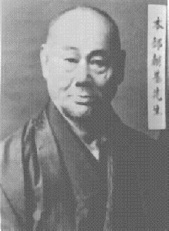
Motobu Choki (1871 -1944)
Motobu was born in Shuri, third son to a distinguished family. In that time, attention and education were granted mainly to family successor, which was the firstborn son - especially if traditional art was being involved. The first born brother in Motobu family was Choyu and he was obviously the natural successor of the traditional family Fighting Art, the "Motobu Udon Ti", while the other brothers, Choshin and Choki were secondary. Therefore Motobu Choki covertly learned the art of fighting.
He gained the nickname "Motobu saru" ("The monkey man") for his strength and agility.
In his youth, Motobu Choki were known as a belligerent person who seeks for fights in order to examine techniques he head learned, hence teachers refused to accept him as their student.
Choki focused on efficiency and effectiveness in techniques and implemented each and every movement. Although Motobu has not established a new style ("Ryu"), he tremendously influenced on Karate.
For the record, there is a difference between Motobu Choki's Karate and "Motobu Ryu" \ "Motobu Udon Ti", the family art that is mentioned above and was taught by Motobu Choyu, the firstborn brother.
In 1921 Motobu Choki moved to Osaka\Japan with his family.
In September 1925, there was an event which was published by the popular "Kingu" ("king") magazine and gained headlines that raised the Okinawan "Te" into the public awareness. At that time aggressive fights were held among Japanese and western fighters. Karate was still unfamiliar to Japanese society. The event was occurred in Kyoto in participation of professional boxer (German or Russian who was named "George"). People from the audience were invited to try out there skills against the competitors and Choki Motobu, who was at the age of 50, willingly volunteered. The short match was ended by Motobu Choki's victory after the boxer was stroke down unconsciously on the floor. When Motobu was asked for his fighting style he simply replied: "Nothing special, just Ryukyu Te".
Magazine "Kingu" article
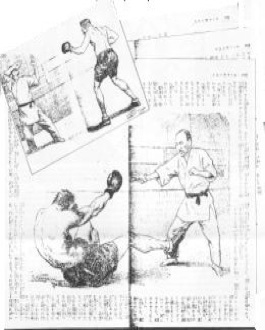
The magazine was printed in more then million copies and publicized Karate ("Okinawan Te" at that time) in Japan.
Motobu Choki wrote two books that were published in 1926, both emphasize applicative fighting techniques and one of them ("Watashi no Karate-Jutsu") also refers to Naihanchi Kata.
In 1927 Motobu Choki moved to Tokyo. In autumn 1936 he traveled back to Okinawa in order to delve into Karate and Kobudo. In spring 1939 Motobu as returned to reside in Okinawa.
Among Motobu Choki teachers we can include: Anko Itosu - "Shuri-Te", Kasoku Matsumora - "Tomari - Te", Kanagusuku and Sakuma of Gibo.
Among his students we can include: Yasuhiro Konishi - founder of "Shindo Jinen Ryu", Kose Kuniba - founder of "Seishin Kai" and Hironori Ohtsuka - founder of Wado Ryu and Shoshin Nagamine, founder of Matsubayashi Shorin-ryu.
Personal History of Shoshin Nagamine
Record
-
•July 15, 1907, Born in Tomari-son, Naha City, Okinawa, Japan.
-
•March, 1928, Graduated from Naha City-run Commercial School.
-
•January, 1929, Enrolled in the 47th Infantry Division, Oita Prefecture. Dispatched to the skirmishes of Sainan, China in April the same year.
-
•December, 1931, Appointed prefectural policeman of Okinawa.
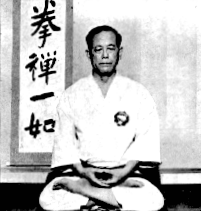
-
•January, 1951, Promoted to senior superintendent and chief of police of Motobu Police Station.
-
•January, 1952, Retired the position mentioned above.
-
•January, 1953, Founded a full-scale Karate Dojo in Naha City, While teaching Karate, served as Naha municipal assemblyman for three terms, and worked as a member of board directors of a firm. Presently teaching Karate.
Decorations
-
•April, 1929, Bestowed by Decoration Bureau, Prime Minister's Office, the Eighth Order of Merit, in recognition of military service during the Sainan skirmishes in China.
-
•1977, Won a prize for teaching Karate and physical education promotion from the Okinawa Times.
-
•November, 1977, Awarded the Prize for Sports and Physical Education by Okinawa Prefectural Office.
-
•April, 1988, Bestowed the Order of Rising Sun, Fifth Class, with Star and Ribbon, by Decoration Bureau, Prime Minister's Office.
Books Written
-
•February, 1975, Shijitsu-to Dentoo-mamoru-Okinawa-Karatedo, (Historical Facts of Traditional Okinawa Karate), by Jinbutsu Oraisha Publishing Company.
-
•February, 1975, The Essence of Okinawan Karate-do (English), by Charles E. Tuttle Company.
-
•March, 1975, Spanish translation of the above book.
-
•June, 1986, Okinawa Karate and famous Okinawan Sumo Wrestlers, by Jinbutsu Oraisha Publishing Company.
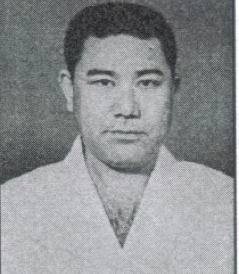
Shoshin Nagamine did not permit sparing at the Hombu Dojo, this caused several of Sensei Nagamine top students to make arrangements to start a new school. Shima Sensei founded a Dojo together with Kishaba & Taba Sensei. This was at the beginning of the fifties, shortly after their Dan graduations.
Shima Sensei did not charge anyone to practice at his new dojo, but due to lack of water the students support the school by bringing water, if you have ever been to Okinawa during summer time you would learn quickly how hot and humid it is and water is of great importance during training in the evening since day time training is not recommended.
Shima Sensei’s dojo had no more than ten or more students, when visiting Okinawa, Sensei Shima and his students had a yearly celebration and saw one another, the number of students that showed up each year were no more than a dozen.
Kata was still of the utmost importance at the Shima Dojo followed by strength training and Chi'shi, The name chishi is composed from two parts; Chi - means energy or power, and Ishi - means stone. This equipment is intended to strengthen the inner power, the grip and the wrists. The chishi is also good to strengthen, among other parts, the shoulders and forearms. It helps to develop the thrust and some kind of blocks like Hiki Uke. Weapons were also practiced.
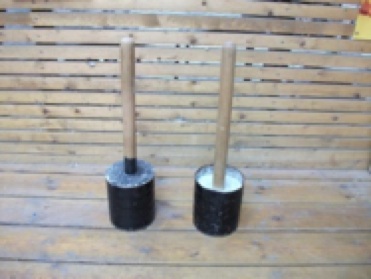
The instruction at Shima dojo also included Sensei TABA and Sensei KISHABA, this was a force from Nagamine Dojo. Shima’s Dojo was known for the rough training and fighting, in opposite to the rather Kata oriented Dojo of Nagamine. Sensei Shima’s Dojo was located in Kanzatobaru, Naha City. Some of the well known students of Sensei Shima were, among others, Toshiro Oshiro and Eihachi Ota.
Masao Shima, (1931-2000) Chokei Kishaba and Kensei Taba (1933 -) founded the Shima Dojo. This was under the direction of Sensei Shima.
Shima Sensei 10th Dan lived in Los Angeles for a year. In Okinawa, one student at the yearly dinner party was asked “would you want to go back to the training you once had with Sensei Shima?”, he paused and said “no”, when asked why he said “we called him the devil due to the brutal training” but he also added “I would never change what he learned”. In the U.S. students called him "Master of Shadows".